




B.E. Civil Engineering
Build the skills to design, construct, and manage the infrastructure that shapes the modern world- from buildings, bridges, and highways to water resources, environmental systems, and smart cities. The B.E. Civil Engineering programme at AVIT combines strong engineering fundamentals with hands-on expertise in structural analysis, geotechnical engineering, construction management, and modern CAD & BIM technologies.
PROGRAMME OVERVIEW
Building a Sustainable and Resilient Future
Civil Engineering at AVIT empowers students to become builders, innovators, and problem-solvers across the entire infrastructure landscape. Established in 2008, the department blends strong foundations in structural engineering, geotechnical engineering, transportation, and water resources with specialized pathways in Structural Design, Construction Management, Environmental Engineering, Transportation Engineering, and CAD & BIM-driven design.
Home to the Centre for Concrete Research, the department drives applied research that has resulted in 21+ patents, supporting innovation in construction materials, sustainable building practices, and infrastructure development. Through industry-grade laboratories, certifications, internships, funded research projects, and collaborations with leading construction and infrastructure partners, students gain real-world experience and future-ready skills. Supported by expert faculty and modern infrastructure, AVIT Civil Engineering prepares graduates for successful careers in structural design, construction, geotechnical and transportation engineering, environmental and water resources engineering, research, and entrepreneurship.



WHY CHOOSE B.E. CIVIL?
Why Choose B.E. Civil Engineering at AVIT?
Build future-ready skills through industry-integrated learning, structural and construction management specializations, advanced research opportunities, and career-focused education designed for the age of sustainable and resilient infrastructure.
Future-Ready Curriculum
Learn structural analysis, reinforced concrete and steel design, geotechnical engineering, transportation, environmental and water resources engineering, and CAD & BIM through an industry-aligned curriculum designed for the modern construction economy.

Industry Partnerships & Certifications
Gain hands-on experience through collaborations with leading construction, infrastructure, and design companies, certification programs, internships, expert mentoring, and real-world project-based learning opportunities.

Centre for Concrete Research
Work in a dedicated Centre for Concrete Research backed by a department with 21+ patents, exploring advanced construction materials, concrete technology, and sustainable building practices.

Emerging Technology Specializations
Choose specialized pathways in Structural Design, Construction Management, Environmental Engineering, Transportation Engineering, and CAD & BIM to align with your career aspirations.

Research, Innovation & Entrepreneurship
Participate in funded research projects, patents, hackathons, innovation challenges, startup incubation initiatives, and multidisciplinary infrastructure and construction development programs.

Career-Focused Learning
Prepare for high-demand careers as Structural Engineers, Site/Construction Engineers, Geotechnical Engineers, Transportation Engineers, Environmental Engineers, Construction/Project Managers, Researchers, and Entrepreneurs.
WHAT YOU'LL STUDY
Your Four-Year Learning Journey
The programme is structured as a progressive learning experience- from engineering fundamentals to advanced structural, geotechnical, and construction systems and real-world applications.

YEAR 1
Engineering Foundations & Scientific Thinking
Focus Areas
- Engineering Mechanics
- Problem Solving using C
- Engineering Mathematics
- Physical Sciences
- Building Materials & Construction
- Communication & Professional Skills
- Design Thinking Foundations
- Engineering Graphics
- Idea Lab
Outcome: Develop strong analytical reasoning, mechanics fundamentals, programming basics, and communication skills required for advanced civil engineering studies.
YEAR 2
Core Civil Engineering Systems
Focus Areas
- Strength of Materials
- Surveying
- Fluid Mechanics & Hydraulics
- Concrete Technology
- Mechanics of Solids
- Soil Mechanics
- Surveying Practicals
Outcome: Build a strong foundation in the mechanics of materials, surveying, fluid behaviour, and construction materials used across civil engineering.

YEAR 3
Structural, Geotechnical & Infrastructure Systems
Focus Areas
- Structural Analysis
- Reinforced Concrete Design
- Steel Structures
- Geotechnical Engineering
- Transportation Engineering
- Environmental Engineering
- Professional Electives
Outcome: Design, analyze, and manage structural, geotechnical, transportation, and environmental systems using modern engineering technologies.
YEAR 4
Industry Integration & Innovation
Focus Areas
- Water Resources Engineering
- Estimation & Costing
- Construction Management
- CAD & BIM
- Internship
- Capstone Project
Outcome: Graduate with industry experience, research exposure, problem-solving skills, and professional readiness.
PATHWAY OPTIONS
Honors, Minors & Specializations
HONORS DEGREE
- Structural Engineering
- Construction Technology & Management
SPECIALIZATIONS
- Structural Design
- Geotechnical Engineering
- Transportation Engineering
MINOR DEGREE OPTIONS
- CAD & BIM for Infrastructure
CAREER OUTCOMES: Structural Engineer | Site/Construction Engineer | Geotechnical Engineer | Transportation Engineer | Environmental Engineer | Water Resources Engineer | Construction/Project Manager

PROGRAMME HIGHLIGHTS
What You'll Achieve with Us
Engineering Graduates will be able to:
Apply the knowledge of mathematics, science, engineering fundamentals, and an engineering specialization to the solution of complex engineering problems.
Identify, formulate, review research literature, and analyze complex engineering problems reaching substantiated conclusions using first principles of mathematics, natural sciences, and engineering sciences.
Design solutions for complex engineering problems and design system components or processes that meet the specified needs with appropriate consideration for the public health and safety, and the cultural, societal, and environmental considerations.
Use research-based knowledge and research methods including design of experiments, analysis and interpretation of data, and synthesis of the information to provide valid conclusions.
Create, select, and apply appropriate techniques, resources, and modern engineering and IT tools including prediction and modeling to complex engineering activities with an understanding of the limitations.
Apply reasoning informed by the contextual knowledge to assess societal, health, safety, legal and cultural issues and the consequent responsibilities relevant to the professional engineering practice.
Understand the impact of the professional engineering solutions in societal and environmental contexts, and demonstrate the knowledge of, and need for sustainable development.
Apply ethical principles and commit to professional ethics and responsibilities and norms of the engineering practice.
Function effectively as an individual, and as a member or leader in diverse / multidisciplinary teams.
Communicate effectively and inclusively within the engineering community and society at large, such as being able to comprehend and write effective reports and design documentation, make effective presentations considering cultural, language, and learning differences.
Apply knowledge and understanding of engineering management principles and economic decision-making and apply these to one's own work, as a member and leader in a team, and to manage projects and in multidisciplinary environments.
Recognize the need for, and have the preparation and ability for i) independent and life-long learning ii) adaptability to new and emerging technologies and iii) critical thinking in the broadest context of technological change.
Graduating Students of Civil Engineering programme will be able to:
-
PSO 1
To work independently as well as in team to formulate, design, execute solutions for engineering problems and also analyse, synthesize technical data for application to product, process, system design & development.
-
PSO 2
To understand & contribute towards social, environmental issues, following professional ethics and codes of conduct and embrace lifelong learning for continuous improvement.
-
PSO 3
To develop expertise towards use of modern engineering tools, careers in industries and research and demonstrate entrepreneurial skill.
Graduating Students of Civil Engineering programme will be able to achieve the following objectives:
-
PEO 1
Graduates will perform as professional engineers in the various fields of Civil engineering.
-
PEO 2
Graduates will perform well in their specialised field and trained in teamwork and leadership positions.
-
PEO 3
Graduates will pursue lifelong learning in their specialised fields of Civil Engineering.
-
PEO 4
Graduates will exhibit entrepreneurship qualities.
-
PEO 5
Graduates will contribute to the development of the profession, Nation, and society.
Dr.S.P.Sangeetha Professor, Department of Civil Engineering, Aarupadai Veedu Institute of Technology, Chennai.
Mr.C.Kathirvel Associate Professor, Department of Civil Engineering, Vinayaka Missions Kirupananda Variyar Engineering College, Salem.
Dr.R.Divahar Associate Professor, Department of Civil Engineering, Aarupadai Veedu Institute of Technology, Chennai.
Mr.M.Senthilkumar Assistant Professor, Department of Civil Engineering, Vinayaka Missions Kirupananda Variyar Engineering College, Salem.
Mr.K.Harish Assistant Professor, Department of Civil Engineering, Vinayaka Missions Kirupananda Variyar Engineering College, Salem.
Mr.K.Naveen Kumar Assistant Professor, Department of Civil Engineering, Aarupadai Veedu Institute of Technology, Chennai.
Dr. D.Shoba Rajkumar Professor & Head, Department of Civil Engineering, Government College of Engineering, Salem.
Mr.V.Angappan Civil Engineer & Valuer, Secretary Association of Licensed Building Surveyors, Aarupadai Veedu Institute of Technology, Salem.
| Date | Name of the Programmes (Webinar/Seminar, Workshop and Conference) | Title of the Programme | National/ International |
|---|---|---|---|
| 25.7.2025 | FDP | Faculty Development Program in Paints and Coatings | National |
| 29.7.2025 | Webinar | The challenges construction projects face due to soil settlement issues | National |
| 30.7.2025 | Webinar | Interactive Training on Bentley Systems Software | National |
| 26.8.2025 | Workshop | Bio concrete for future construction | National |
| Name of the Colleges / Schools | Details of the achievements for Institutional, Faculty & Students |
|---|---|
| Dr.S.P.Sangeetha | Certificate of appreciation and also cash prize for faculty got maximum number of Indian invention patents granted in the calendar year 2024. |
| Dr.R.Divahar | Certificate of appreciation and also cash prize for faculty got maximum number of Indian invention patents granted in the calendar year 2024. |
| Dr.S.P.Sangeetha | Excellence In Research for outstanding achievement in publishing beyond set targets and contribution to the institution and research excellence. |
| Dr.R.Divahar | Excellence In Research for outstanding achievement in publishing beyond set targets and contribution to the institution and research excellence. |
| Mr.Mohammed Rahil /III Year Civil Engineering | Securing I prize in the district level Quiz Competition conducted by Tamilnadu state AIDS control Society (TANSACS) |
 OUR FLAGSHIP INITIATIVE
VEmerge+ Industry Integrated Programmes
Developed in Collaboration With Leading Industry Partners

CAREER OPPORTUNITIES
Where Will Your Degree Take You?
From Structural Design and Construction to Geotechnical, Transportation, Environmental, and Water Resources Engineering, Research, and Entrepreneurship, an AVIT Civil Engineering degree opens pathways to some of the world's most essential and enduring infrastructure careers.
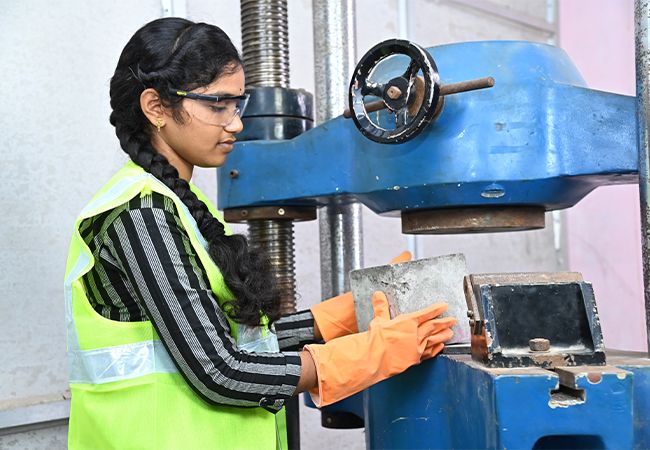
Structural Engineer
Analyze and design buildings, bridges, and structures that are safe, durable, and resilient against loads and environmental forces.
Site / Construction Engineer
Plan, supervise, and execute construction projects on site, ensuring quality, safety, and timely delivery of infrastructure.
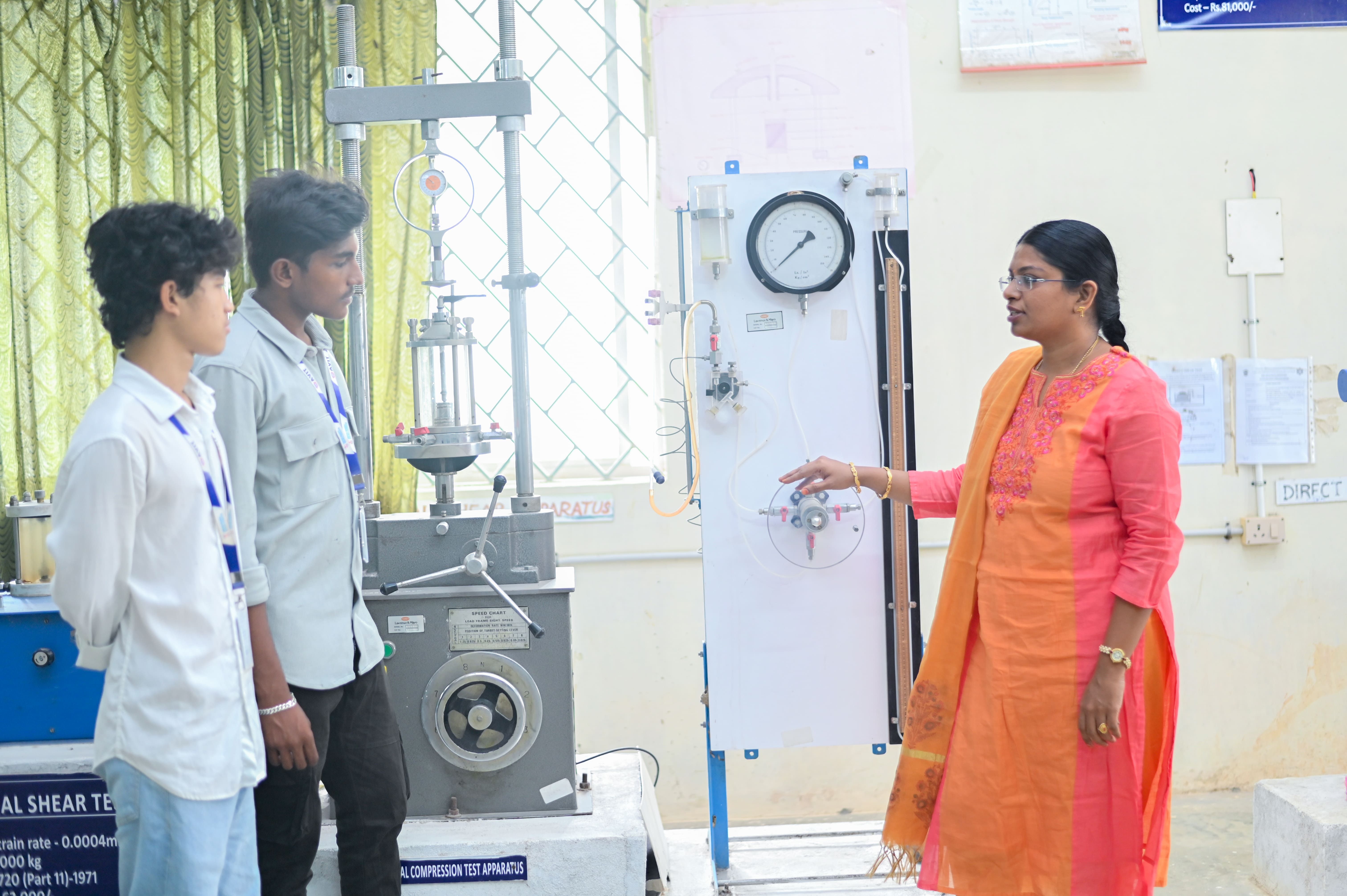
Geotechnical Engineer
Investigate soil and rock behaviour to design safe foundations, retaining structures, and earthworks for infrastructure projects.
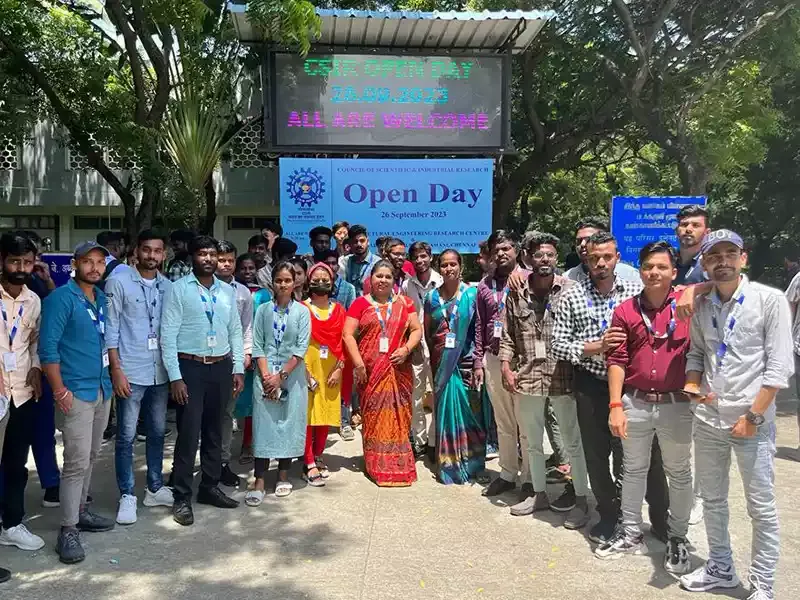
Transportation Engineer
Design and manage highways, railways, and urban transport systems that keep cities and regions connected and moving.
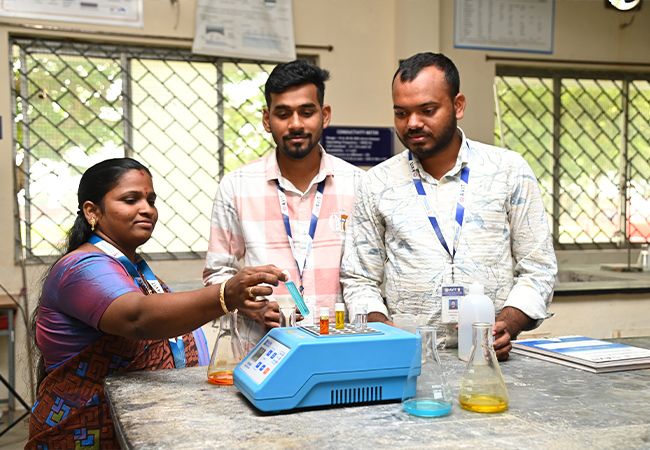
Environmental & Water Resources Engineer
Develop water supply, wastewater treatment, and water resources solutions that protect public health and the environment.

Construction / Project Manager
Lead estimation, costing, scheduling, and management of large construction projects, driving innovation in BIM and smart infrastructure.
LABORATORIES & FACILITIES
Learn in Industry-Grade Labs
Centre for Concrete Research
Concrete mix design, testing & durability studies
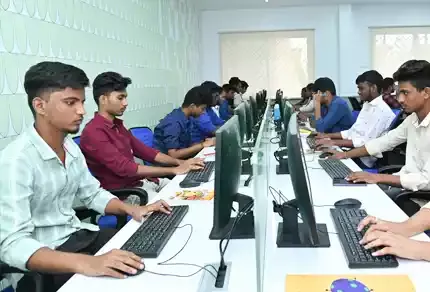
Strength of Materials Lab
UTM, compression & material testing equipment
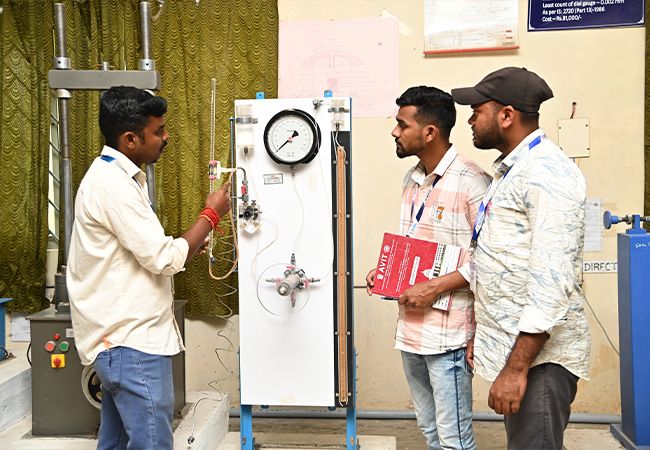
Geotechnical Engineering Lab
Soil classification, shear & consolidation testing
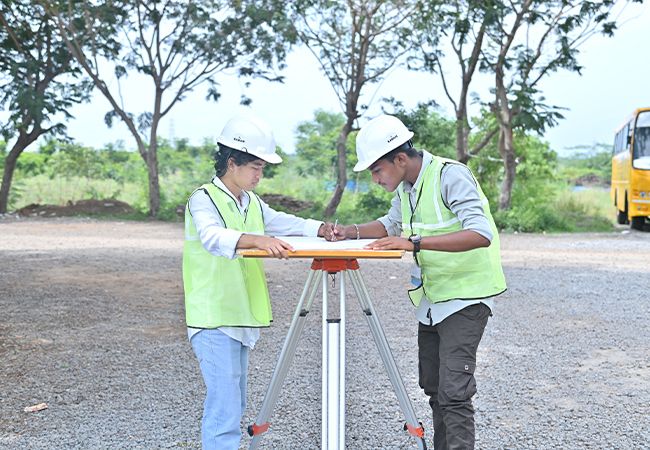
CAD & BIM Lab
AutoCAD, STAAD.Pro & Revit BIM workstations
INTERNSHIPS
Build Your Future with Industry-Integrated Internship Programs
At AVIT, internships connect classroom learning with real-world industry exposure across construction, infrastructure, and design sectors.

Smart Infrastructure Industry Project cum Internship
Assured Internship & Placement, Industry Certifications, Capstone Project

BIM & Digital Engineering Internship
Industry-ready project, NCVET certificate, Placement Assistance
Construction Visualization & XR Internship
AR/VR for construction, structural visualization, Capstone Project
Centre for Concrete Research
Concrete & Materials Research Programme
Real-world construction problems, group projects, enhanced technical skills
RELATED PROGRAMMES
Explore Other Academic Opportunities
Beyond the core B.E. Civil Engineering programme, AVIT offers specialised civil engineering pathways and complementary engineering disciplines- each designed for high-demand infrastructure and core engineering careers.


FREQUENTLY ASKED QUESTIONS
Common Questions About B.E. Civil Engineering
AVIT Civil Engineering combines an industry-aligned curriculum, future-focused specializations in structural design and construction management, the Centre for Concrete Research, advanced laboratories, internships, certifications, research opportunities, and strong placement support to prepare students for successful infrastructure careers.
Students can pursue specialized pathways in Structural Design, Construction Management, Geotechnical Engineering, Transportation Engineering, and CAD & BIM, aligned with emerging industry demands.
Established in 2008, the department hosts the Centre for Concrete Research and has driven applied research resulting in 21+ patents across construction materials, concrete technology, and sustainable infrastructure.
Graduates can pursue careers as Structural Engineers, Site/Construction Engineers, Geotechnical Engineers, Transportation Engineers, Environmental Engineers, Water Resources Engineers, Construction/Project Managers, Surveyors, Quantity Surveyors, Urban/Town Planners, Researchers, and Entrepreneurs.
Yes. Students actively participate in internships, national and international hackathons, technical competitions, funded research projects, patent development, innovation challenges, and startup incubation programs.
The department provides access to the Centre for Concrete Research, Environmental Engineering Lab, CAD Lab, Strength of Materials Lab, Geotechnical Engineering Lab, Surveying Lab, Transportation Engineering Lab, and Hydraulics Lab.
Yes. Students can enhance their academic profile through Honors Degrees, Minor Degrees, and specialized pathways in emerging areas such as structural engineering and construction technology based on curriculum regulations.
AVIT offers placement training, aptitude preparation, technical skill development, mock interviews, industry mentoring, internships, and recruitment opportunities with leading construction, infrastructure, and core engineering companies.
Absolutely. The programme prepares students for higher education, research careers, postgraduate studies, and doctoral programmes in India and abroad.
Students can apply through the AVIT admissions portal or contact the admissions office for guidance on eligibility, application procedures, scholarships, and programme selection.
ADMISSIONS OPEN
Ready to Build the Future?
The world is built by civil engineers- and the demand for skilled professionals driving sustainable infrastructure, smart cities, and resilient construction has never been greater. The B.E. Civil Engineering programme at AVIT provides the foundation, industry exposure, and technical depth you need to build a lasting career in structural design, construction, and infrastructure development.